Sauron feature
The collections your store should have: found, built, and ranked
Your collection pages are your highest-traffic SEO entry points, and most stores are missing half of the ones shoppers actually search for. Sauron reads your whole catalog, finds the category pages that should exist but don't, and builds the winnable ones automatically, each targeting real search demand.
See it work
Watch it run on a real store
Recorded in the Sauron app on our demo store, Marlow & Ash · your store's own products and keywords appear here
Inside the app
See it on your own catalog
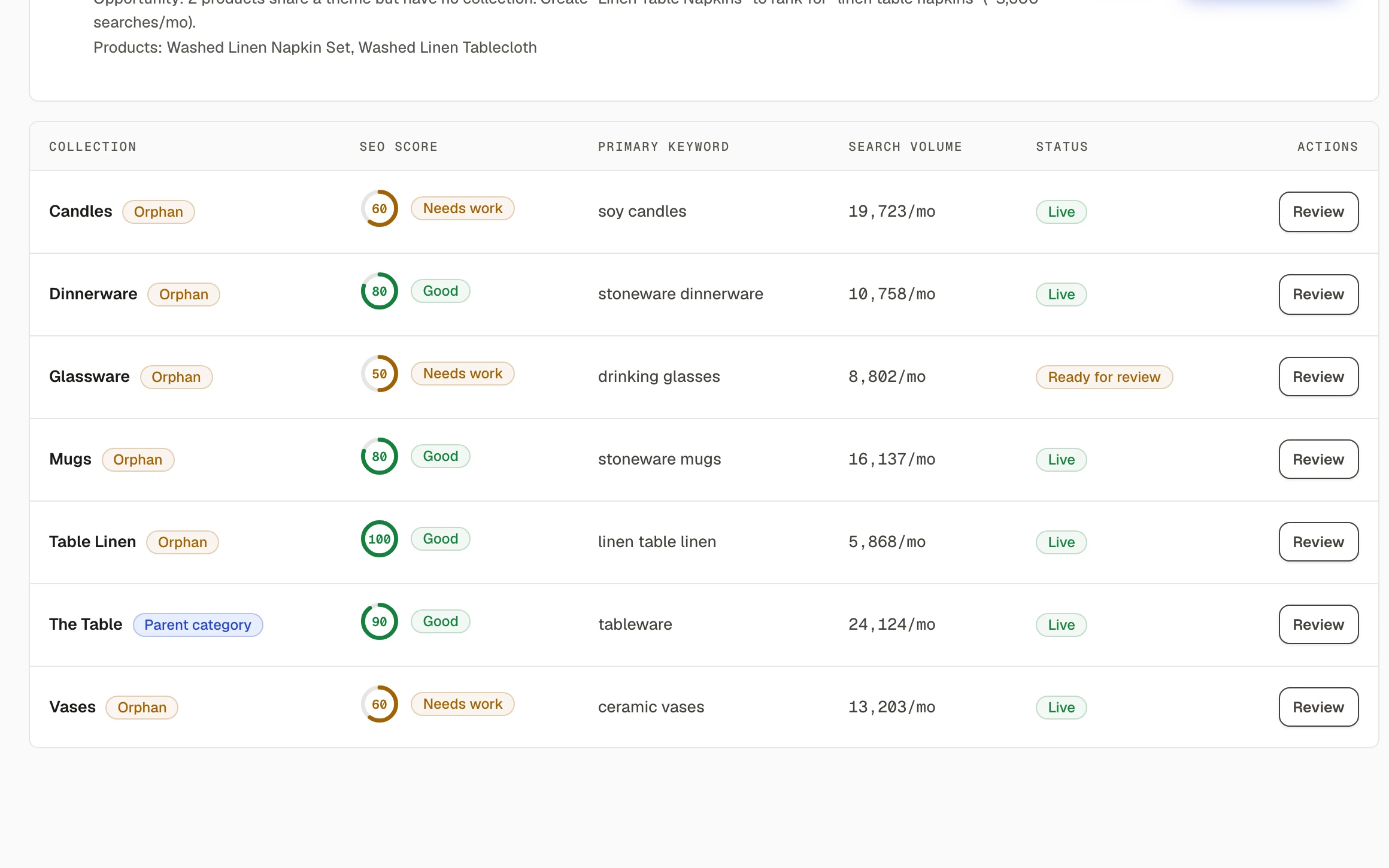
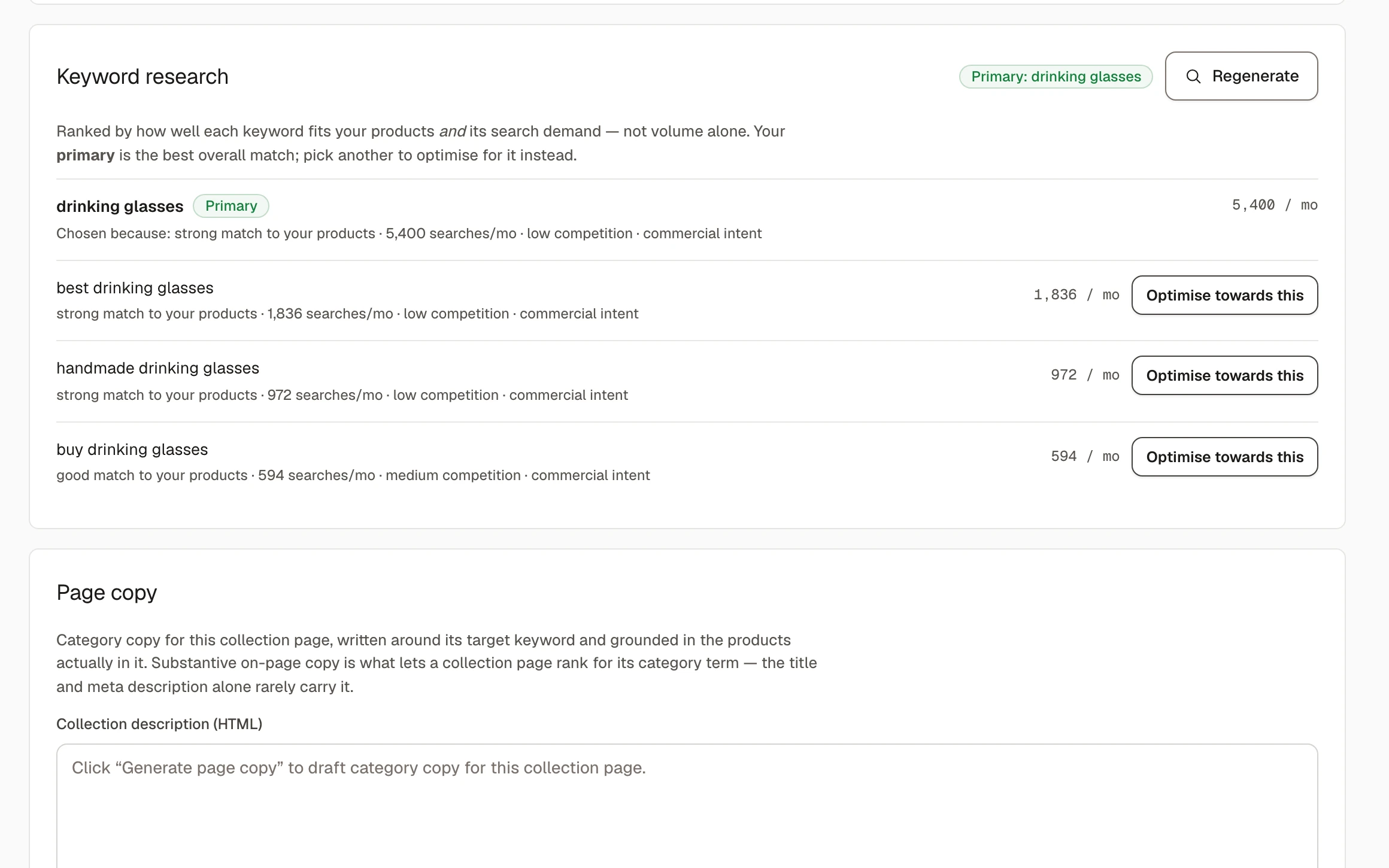
Screens from the Sauron app on our demo store, Marlow & Ash · your store's own products and keywords appear here
The difference
The problem
Why this costs you rankings
Most Shopify stores organise collections around how the merchant thinks ('New Arrivals', 'Summer Picks', 'Shop All'), not how shoppers search. The categories people actually type into Google ('ceramic coffee mugs', 'linen shirts for men') often have no page to land on. And when collections do exist, broad and specific pages compete for the same keyword, cannibalising each other in search.
The solution
How Sauron fixes it
Sauron clusters your entire catalog with AI to find missing categories, validates each one against real Google search volume and ranking difficulty, auto-creates and publishes the winnable ones, and arranges everything into a two-tier parent/sub-category hierarchy where every page targets its own keyword: no cannibalisation, no manual taxonomy work.
How it works
Step by step
Catalog clustering finds the gaps
Sauron reads every product (titles, types, tags, variant attributes) and clusters them into the categories shoppers search for. Categories with no matching collection page become gap suggestions. It also mines your existing keyword data for demand-driven gaps like 'gifts for coffee lovers' that product-first clustering can't see.
Real demand and difficulty scoring
Every suggested collection is validated against real Google search volume and SEO difficulty, including the long-tail cluster around the head term, not just the head term itself. Sauron even checks the live SERP shape, so it never builds a category page for a search that wants an article.
Winnable collections are created automatically
Suggestions with enough demand, enough products, and a realistic shot at ranking (scored against your store's own domain authority) are created and published to your Online Store automatically, within your plan's monthly budget. Everything else waits as a reviewable suggestion. You stay in control with a master toggle.
Hierarchy, copy, and upkeep
Collections are organised into broad parents over specific children ('Knitwear' over 'Aran Jumpers'), with each tier locked to its own keyword tier. Sauron writes SERP-informed titles, meta descriptions, and body copy that links parents down to subcategories, splits mixed collections when products don't fit the target keyword, and keeps membership current as your catalog grows.
Benefits
What you get
Pages for demand you're missing
Every gap Sauron finds is a search query with real volume and no page to rank for it. Creating the page is the single highest-leverage SEO action a store can take, and Sauron does it while you sleep.
No keyword cannibalisation
The parent/sub-category hierarchy assigns broad head terms to parent pages and specific long-tail terms to children, so 'Knitwear' and 'Cashmere Cardigans' each win their own keyword instead of fighting over one.
Judged against your actual products
Keyword research for each collection is scored against the products actually in it, not the collection's name. A broadly-named collection holding two products can't drift onto a huge head term it will never rank for.
Plan availability
Used most by
Niches where Collection SEO & Gap Finder has biggest impact
Questions
Collection SEO & Gap Finder FAQ
Will Sauron create collections without my approval? +
Only if you let it. Auto-create is governed by a master toggle, a monthly budget on your plan, and hard quality gates: minimum real search volume, minimum product count, and a winnability check against your store's domain authority. Suggestions that don't clear the bar wait for your manual review. You can also run in suggestions-only mode.
How does Sauron know a collection is worth creating? +
Each suggestion is validated with real Google search volume data, scored for ranking difficulty against your own domain authority, and checked for the long-tail demand around the head term. Sauron even inspects the live search results: if Google is answering that query with articles rather than category pages, the collection isn't created.
What stops my collection pages competing with each other? +
Sauron builds a two-tier hierarchy: broad parent collections lock the encapsulating head term ('knitwear'), and specific child collections are actively demoted off those reserved head terms onto their own long-tail keywords ('aran jumpers'). Each tier targets a different keyword tier by design.
What happens when products don't fit a collection's keyword? +
Sauron detects misfits (a linen tote in a 'linen shirts' collection) and proposes a split into a new, demand-validated collection. For collections Sauron created, splits resolve automatically; for collections you built by hand, you get a review card and nothing changes without your say-so.
Start using Collection SEO & Gap Finder today
Free plan available. Paid plans include a free trial, billed through Shopify, cancel any time.